


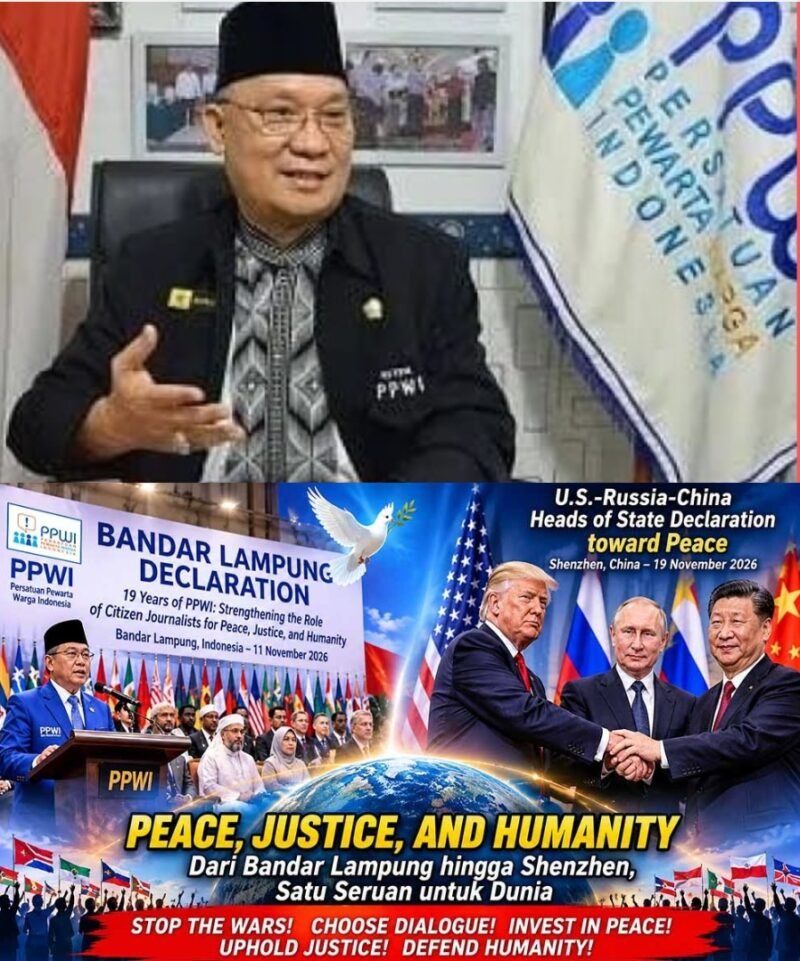
JAKARTA, November 2026 — World peace is not only the responsibility of presidents, governments, and powerful nations. Civil society organizations, journalists, and individuals guided by strong moral convictions also have an important role to play in shaping a more peaceful world.
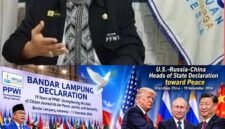
This message was brought to the international community by Wilson Lalengke, Chairman of the Indonesian Citizen Journalists Association (Persatuan Pewarta Warga Indonesia – PPWI), through the Bandar Lampung Declaration, launched on November 11, 2026.
Just eight days later, on November 19, 2026, international attention reportedly turned to Shenzhen, China, where United States President Donald Trump, Russian President Vladimir Putin, and Chinese President Xi Jinping were said to have met and issued a joint declaration toward peace.
Two declarations. Two different stages. Eight days apart.
One emerged from civil society in Indonesia. The other was reportedly associated with leaders of three major world powers. Yet both brought attention to the same fundamental concern: the need to protect peace and prevent conflicts that could threaten humanity’s future.
But this unusual sequence of events raises deeper questions.
Was it merely a coincidence that two peace initiatives appeared within such a short period? Was there an unseen arrangement or a larger design connecting these moments? Could there be a force beyond human control guiding events in ways that people do not fully understand? And, perhaps most importantly, what does this mean for humanity?
These questions deserve reflection, not premature conclusions.
There is no established evidence that the two declarations were coordinated or that one influenced the other. Nevertheless, their close timing offers an opportunity to consider whether the growing call for peace reflects a deeper awakening of human consciousness at a time when the world urgently needs wisdom, restraint, and cooperation.
For Wilson Lalengke, the Bandar Lampung gathering was more than a celebration of PPWI’s 19th anniversary. It was an opportunity to bring the ideas and aspirations of Indonesian citizen journalists into the global conversation on peace, justice, freedom, and humanity.
WILSON LALENGKE AND THE POWER OF CIVIL SOCIETY DIPLOMACY
Under Wilson Lalengke’s leadership, PPWI has sought to expand the role of citizen journalists beyond simply reporting the news. The organization also aims to encourage public participation in democratic life, social responsibility, and humanitarian efforts.
The Bandar Lampung Declaration reflects this commitment.
At an international forum held on November 11, 2026, at Hotel Emersia in Bandar Lampung, PPWI brought together diplomats, academics, media figures, activists, and international partners to discuss the challenges facing world peace.
Among the diplomatic representatives reported to have attended were Russian Ambassador to Indonesia Sergey Gennadievich Tolchenov, Syrian Ambassador Abdulmonem Annan, and Tamou Samri, a representative of the Moroccan Embassy.
The forum highlighted several important principles: ending armed conflicts, resolving disputes through dialogue, respecting human rights, protecting civilians, and promoting responsible journalism.
It also emphasized the need to give greater attention to human development, education, healthcare, poverty reduction, and public welfare.
Through this initiative, Wilson Lalengke presented a broader vision of journalism. Journalists should not merely record wars and conflicts. They can also help promote understanding, share the truth, encourage dialogue, and give a voice to communities affected by violence and injustice.
This approach demonstrates the potential of civil society diplomacy as an important complement to official government diplomacy.
A declaration issued by a civil society organization may not carry the legal authority of a state agreement. Yet its moral significance should not be underestimated. Ideas can cross borders, shape public discussion, and encourage people to reconsider the consequences of hatred, violence, and indifference.
EIGHT DAYS APART: COINCIDENCE, A LARGER DESIGN, OR A CALL TO REFLECT?
The interval between Bandar Lampung and Shenzhen is striking. On November 11, a civil society forum in Indonesia raised a call for peace. On November 19, a reported meeting involving three major world leaders brought another declaration associated with international peace.
Naturally, people may ask: is this simply a coincidence?
From a factual perspective, the available information does not establish a direct connection between the two events. There is no confirmed basis to claim that the Bandar Lampung Declaration triggered, influenced, or was part of the reported Shenzhen initiative.
But not every meaningful question must begin with an assumption of direct coordination.
History sometimes presents events that occur close together and invite people to look beyond their immediate circumstances. Such moments can encourage reflection about the direction of human civilization, the limits of political power, and the shared responsibilities of nations and individuals.
Could there be a larger design behind these events? Could a force beyond human understanding be at work?
For people of faith, the question may lead to reflection on divine providence: the belief that human history unfolds within a greater order that people cannot always comprehend. For others, it may be understood as the convergence of historical circumstances, political pressures, and the growing awareness that humanity cannot afford another catastrophic conflict.
Neither interpretation should be presented as an established fact. Human beings must remain humble when interpreting events whose full causes and consequences are not yet known.
What can be said with greater confidence is that both moments, as described, point toward a common moral imperative: humanity must choose dialogue over destruction, cooperation over hostility, and human dignity over the pursuit of domination.
Perhaps the most important question is therefore not whether the two declarations were secretly connected, but whether the world is prepared to take their shared message seriously.
SHENZHEN AND THE GLOBAL CHALLENGE OF PEACE
Eight days after the Bandar Lampung Declaration, the reported meeting in Shenzhen brought a different dimension to the international peace agenda.
The reported participation of Donald Trump, Vladimir Putin, and Xi Jinping attracted attention because their countries have enormous influence on global security, economic relations, and international politics.
The declaration associated with the meeting was described as addressing several strategic issues, including United Nations reform, energy security, international relations, and the reduction of nuclear risks.
One of its central messages was clear: a nuclear war cannot be won and must never be fought.
Such a principle carries enormous significance. A nuclear conflict would not simply be a confrontation between governments or military forces. Its consequences could extend across generations, affecting civilians, the environment, food systems, public health, and the future of human civilization.
However, diplomatic commitments must be followed by concrete action. International stability cannot be achieved through statements alone. It requires consistency, respect for international law, meaningful dialogue, and a genuine willingness to resolve disputes peacefully.
In this context, the Bandar Lampung Declaration and the reported Shenzhen declaration can be viewed as two different initiatives addressing a shared concern: protecting peace and the future of humanity.
One speaks from the perspective of civil society and humanitarian responsibility. The other is associated with the strategic responsibilities of major powers. Their authority and influence are different, but the need for peace is universal.
FROM CITIZEN JOURNALISM TO GLOBAL AWARENESS
One important aspect of Wilson Lalengke’s leadership is his effort to connect journalism with broader humanitarian concerns.
In armed conflicts, ordinary people are often among those who suffer the most. Families lose their homes, children lose access to education, healthcare facilities are damaged, and entire communities face uncertainty about their future.
Citizen journalists can help bring these realities to international attention through reporting, documentation, and the sharing of public concerns.
PPWI therefore has the opportunity to contribute to peace journalism, strengthen communication across national borders, and encourage greater public participation in international issues.
For Wilson Lalengke, journalism must remain independent, truthful, and responsible. It should not become a tool for propaganda, hatred, or hostility.
This vision also connects with the ideas of German philosopher Immanuel Kant, particularly his work Perpetual Peace, which emphasizes the importance of law, international cooperation, and fair relations among nations.
Peace, in this sense, means more than the absence of war. It also requires justice, freedom, security, and respect for human dignity.
The role of journalism is especially important in an era when misinformation, political polarization, and inflammatory narratives can deepen divisions between nations and communities. Responsible reporting can help people understand the facts, recognize the human consequences of conflict, and resist efforts to turn differences into hatred.
WHAT DO THESE TWO MOMENTS MEAN FOR HUMANITY?
The significance of Bandar Lampung and Shenzhen should not be measured merely by the dates on which their declarations were announced.
Their deeper meaning lies in the questions they raise about humanity’s direction.
First, peace cannot be left exclusively to governments. Citizens, journalists, educators, religious and community leaders, and civil society organizations all have a responsibility to encourage peaceful solutions.
Second, power must be accompanied by responsibility. Countries with significant military, economic, and political influence have a particular duty to prevent escalation and protect the lives of ordinary people.
Third, declarations must become action. A commitment to peace is meaningful only when it leads to reduced violence, protection for civilians, respect for human rights, and genuine opportunities for dialogue.
Fourth, humanity must learn to recognize its shared destiny. Whatever their nationality, religion, political system, or cultural background, people ultimately share one planet and depend on its continued stability.
If the two events offer any lasting lesson, it is that the future cannot be secured by weapons, rivalry, or domination alone. It must also be built through wisdom, justice, mutual respect, and a willingness to recognize the humanity of others.
LEADERSHIP MUST BE MEASURED BY ACTION
The launch of the Bandar Lampung Declaration represents an important moment. However, its long-term value will depend on what happens next.
This is where Wilson Lalengke and PPWI face their next major challenge: turning the declaration into a lasting initiative with meaningful results.
Possible steps include expanding international citizen journalism networks, organizing dialogue between communities, promoting peace journalism education, developing humanitarian partnerships, and presenting civil society recommendations to international institutions.
These efforts could also create opportunities for Indonesia to strengthen its contribution to international civil society diplomacy, complementing the country’s official diplomatic role.
PPWI does not speak on behalf of the Indonesian government and does not exercise the diplomatic authority of a state. Its contribution comes through ideas, public communication, and active civil society participation.
This is precisely where civil society organizations can make a difference: by ensuring that the voices of ordinary people and humanitarian values remain part of discussions about the world’s future.
For Wilson Lalengke, the challenge is to ensure that the Bandar Lampung Declaration does not remain only a historical record of an anniversary event. It must be followed by sustained communication, cooperation, and measurable efforts to advance its principles.
FROM BANDAR LAMPUNG TO SHENZHEN: A MESSAGE BEYOND BORDERS
The eight-day interval between the Bandar Lampung Declaration and the reported Shenzhen declaration offers an interesting picture of the different paths through which peace can be pursued.
In Bandar Lampung, Wilson Lalengke and PPWI raised the voice of civil society and citizen journalists. In Shenzhen, three world leaders were reportedly associated with a declaration addressing strategic issues affecting international stability.
The two initiatives differ in authority, influence, and responsibility. Yet they can be considered within a broader understanding: peace requires contributions from everyone, from national leaders to ordinary citizens.
Was it coincidence? Was there a larger design? Is there a force beyond human understanding that gives meaning to the sequence of events? These questions may remain open to interpretation.
But one responsibility is clear: people must not wait for history to provide all the answers before choosing to do what is right.
Every nation can contribute to peace. Every organization can promote understanding. Every journalist can report responsibly. Every individual can refuse to spread hatred and choose dialogue instead.
For Wilson Lalengke, this moment offers an opportunity to expand PPWI’s role in international discussions. The challenge is not simply to introduce a declaration, but to ensure that its message continues through cooperation, dialogue, and practical action.
Ultimately, the success of any peace initiative should not be measured by the number of declarations issued, the prominence of the people signing them, or the grandeur of the venues where they are announced. It should be measured by the positive changes they bring to people’s lives.
From Bandar Lampung, Indonesia, Wilson Lalengke brings a message from civil society to the world: peace is not the exclusive responsibility of powerful nations. It is a shared responsibility of all humanity.
Perhaps the most important meaning of these two moments is not that one event caused the other, or that their timing proves the existence of a hidden arrangement. It is that humanity is repeatedly reminded of a choice it cannot avoid: to continue competing for power at the expense of life, or to build a future in which justice, dignity, and peace are shared by all.
Peace is not the privilege of powerful nations. It is the fundamental right of all humanity.